Presentation / Feedback & Reflection
Education
https://drive.google.com/file/d/1VmGOrK2mPTTyWg-cY5RTXyXcZlU_k3to/view?usp=sharing
Reflection on Presentation Task 3B
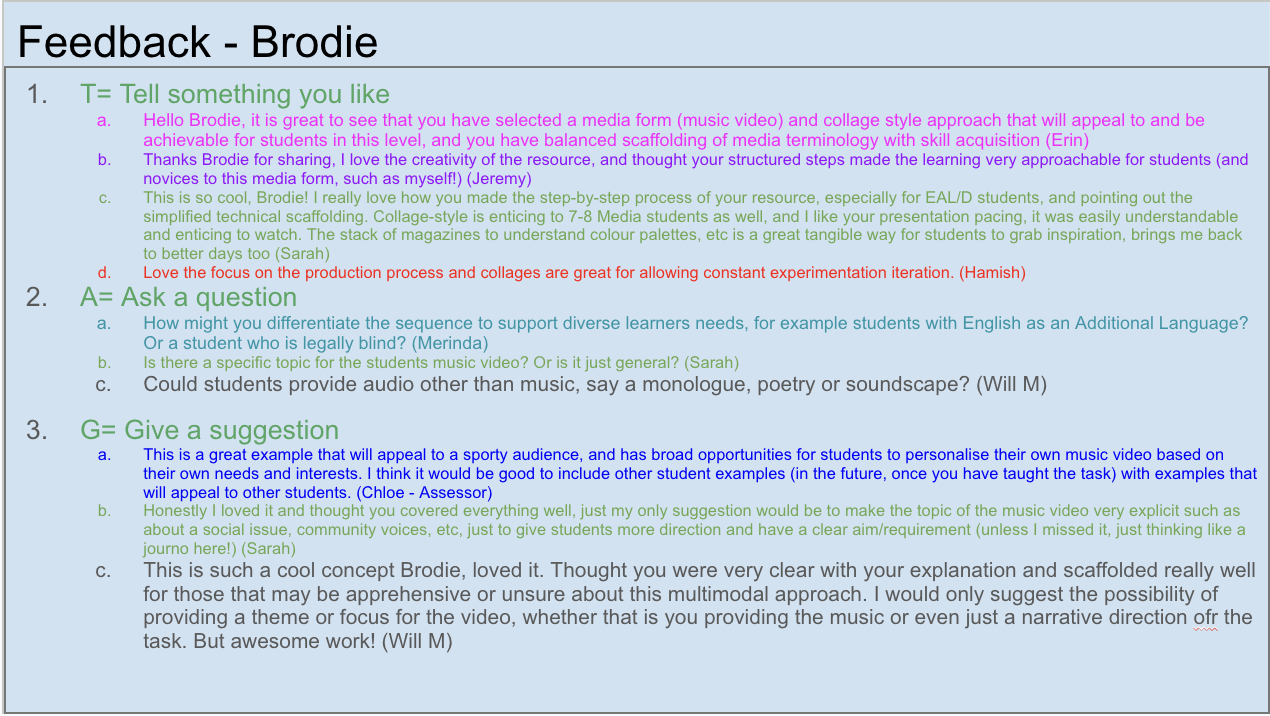
My presentation of a worked example and scaffolded resource for a collage-style music video highlighted the importance of structure and accessibility for junior secondary learners. A key strength identified through peer feedback was the clarity of sequencing and scaffolding, which made the production process “very approachable for students and novices” (Jeremy) and supportive of diverse learners. This affirmed my intention to reduce cognitive load by breaking complex media production into manageable stages, aligning with cognitive load theory (Sweller, 1988). Formative feedback raised important considerations around differentiation and inclusivity. Questions such as how the sequence could support students who are legally blind (Merinda) and whether students could extend beyond music to include monologue or soundscape elements (Will M) highlighted the need for broader accessibility and task flexibility. These prompts encouraged me to consider more explicit integration of alternate media forms to ensure equitable participation across diverse learning needs. Additional suggestions focused on improving task clarity and direction, particularly the inclusion of a more explicit thematic focus for the music video (Sarah). This feedback highlighted the tension between open-ended creative inquiry and the need for sufficient structure to guide student production. It prompted reflection on how task constraints can support rather than limit creativity by providing clearer parameters for success. Overall, I felt my presentation demonstrated an alignment between curriculum intent, scaffolding, and multimodal learning design. However, peer feedback identified key areas for refinement, particularly in differentiation, accessibility, and task framing. Moving forward, I will refine the resource to include clearer conceptual boundaries while maintaining opportunities for student agency, creative expression, and inclusive participation across diverse learner profiles.
Reference
Sweller, J. (1988). Cognitive load during problem solving: Effects on learning. Cognitive Science, 12(2), 257–285. https://doi.org/10.1207/s15516709cog1202_4